
Water Aerobics Is So ‘80s
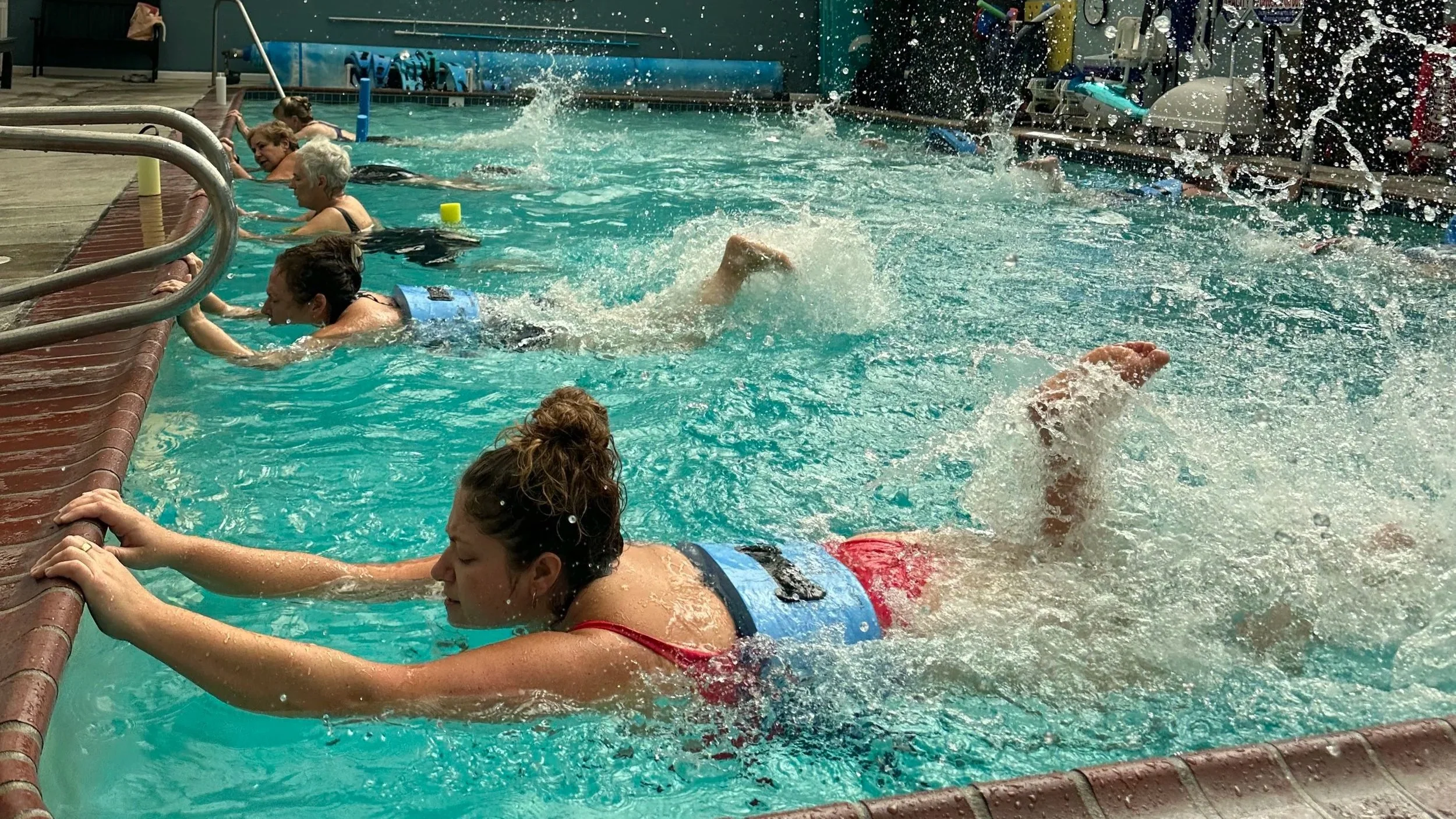
From the aerobics boom of the 1980s to the CrossFit, HYROX, Peloton, and Pilates workouts of today, group fitness has come a long way. It's time our terminology caught up. That means you, water aerobics.
Close your eyes and picture a water aerobics class. What do you see? A group of older women standing in the shallow end of a pool, moving their arms and legs to music while an instructor leads them in eight-count sequences?
If that's what comes to mind, you're not alone. But if that's what you think aquatic fitness looks like today, you might be surprised.
The term "water aerobics" has been around for decades. It represents an important chapter in the history of aquatic exercise, but the industry has evolved well beyond its original identity. At Anderson Aquatics, we've intentionally moved away from the term because it no longer accurately represents what we do. To understand why, let's take a little trip back in time.
How Water Aerobics Made a Splash
In 1968, Dr. Kenneth Cooper published Aerobics, introducing a structured approach to improving cardiovascular fitness. During the 1970s and 1980s, aerobics became increasingly synonymous with choreographed group exercise. Music, rhythm, coordinated movements, and energetic instructors became hallmarks of the fitness movement. Naturally, fitness professionals began adapting these workouts to swimming pools.
By the 1980s, water aerobics was gaining popularity as a low impact alternative to traditional land-based exercise. Classes frequently featured shallow water movements adapted from aerobics routines, often performed to music and organized into choreographed sequences. Water aerobics helped introduce generations of people to the benefits of exercising in the pool. It offered an accessible, enjoyable, and social way to improve fitness, particularly for individuals who found land-based exercise uncomfortable or intimidating.
The industry also began establishing its own professional identity. The Aquatic Exercise Association (AEA), incorporated in 1984, helped advance instructor education, certification, and aquatic exercise programming. As our understanding of exercise science and the unique properties of water expanded, so did the possibilities for aquatic fitness.
Beyond the Eight-Count: The Evolution of Aquatic Fitness
Water isn't simply a low impact way to perform land-based exercises. It creates an entirely different training environment, one that offers opportunities for cardiovascular conditioning, strength development, balance, stability, and athletic performance.
Buoyancy reduces the effects of gravity and weightbearing forces, while water's viscosity, or resistance, creates opportunities to challenge muscles throughout a movement. Hydrostatic pressure, turbulence, and the other properties of water further influence how our bodies respond to exercise.
And unlike traditional weight training, where resistance is primarily determined by the dumbbell we select, resistance in the water can be manipulated in a variety of ways. We can change movement speed, lever length, surface area, body position, direction of movement, and equipment to alter the demands of an exercise.
The water isn't just where we exercise. It's part of the equipment we use to exercise.
As aquatic fitness professionals became more sophisticated in their understanding and application of these principles, aquatic exercise programming expanded. Today, water fitness encompasses everything from gentle movement and rehabilitation-oriented exercise to high intensity interval training, muscle strengthening, deep water running, core conditioning, balance training, and sport-specific conditioning.
And while traditional water aerobics was often associated with general cardiovascular exercise, modern aquatic fitness programs can be designed around specific training objectives, fitness levels, and individual goals.
At Anderson Aquatics, our Pool to 5K program is a perfect example. Our participants don't spend ten weeks learning dance routines in the pool. They train. They perform cardiovascular intervals, build endurance, develop strength, and challenge their bodies in preparation for a real-world athletic event. In September, our squad of 25 walkers and runners completed a 5K or 10K race, demonstrating what consistent aquatic training, determination, and teamwork can accomplish.
That's not simply water aerobics. That's athletic conditioning.
Why We No Longer Depend on Music and Choreography
One of the most noticeable differences between traditional water aerobics and the workouts we offer at Anderson Aquatics is our approach to music and choreography.
In traditional aerobics-based programming, music often determines the tempo, rhythm, and structure of the workout. Participants follow an instructor through a series of coordinated movements, frequently organized into eight-count sequences. There's nothing inherently wrong with this approach. Music can create energy, motivation, and a sense of community. Choreography can be enjoyable, cognitively engaging, and physically demanding.
But neither is necessary to create an effective workout.
A fast song doesn't automatically create a challenging workout, and a slow song doesn't necessarily mean the workout is easy. Intensity in the water is influenced by movement mechanics, resistance, duration, effort, and exercise selection—not simply the beat of the music.
Consider two participants performing the same exercise at the exact same tempo. One may be working near their maximum capacity, while the other is barely challenged. Differences in strength, fitness, technique, and movement execution can produce dramatically different training demands. When everyone is expected to follow the same sequence at the same pace, individualizing exercise intensity can become difficult.
In our classes, participants may perform the same general exercise while working at different speeds, using different equipment, or modifying their movements to achieve an appropriate level of challenge. We're less interested in whether everyone is moving in sync and more interested in whether everyone is getting the workout they came for. Our workouts are designed around specific training objectives. A cardiovascular interval serves a different purpose than a strength-focused circuit. A core stability challenge is different from a shallow water balance exercise. Each has a place in a thoughtfully designed fitness program.
And the instructor's role extends beyond leading a routine. We're coaching movement, monitoring effort, providing modifications, and helping participants progress. We don't need a 128 beats-per-minute song to tell us how hard to work. We use exercise science, thoughtful programming, and the unique properties of water to create an effective workout.
So Why Have We Abandoned the Term "Water Aerobics"?
Simply put, it no longer tells the whole story.
The word aerobics suggests cardiovascular exercise, particularly to people who associate it with traditional group fitness. But aquatic fitness encompasses so much more. Strength training. Core conditioning. High intensity intervals. Deep water running. Balance training. Yoga. Athletic conditioning.
Calling everything we do "water aerobics" is a little like calling every workout in a gym a spin class.
The term also carries a stereotype that has proven difficult to shake.
For many people, water aerobics conjures images of gentle movement, senior fitness, or rehabilitation. These activities are valuable and deserve their place in the fitness industry, but they don't represent the full spectrum of aquatic exercise. Unfortunately, this perception may discourage people who could benefit tremendously from water-based training, particularly younger adults, athletes, and individuals looking for a challenging workout.
We want people to choose the pool because they recognize its potential, not overlook it because they think it's only for someone else.
And there's another important consideration: professionalism.
Aquatic fitness is a specialized field. Qualified instructors study exercise physiology, biomechanics, program design, and the physical properties of water. Effective aquatic programming requires more than simply transferring familiar land-based exercises into a swimming pool.
We're not simply taking exercise into the water. We're using the water to create exercise.
At Anderson Aquatics, our goal is to provide purposeful, effective workouts that challenge participants appropriately, regardless of their age, background, or fitness level. That doesn't mean every class is appropriate for every person. Our programs have different objectives, intensities, and levels of difficulty, just as you would expect from any other professional fitness facility. Someone returning to exercise may have very different needs than someone preparing for a race. Both belong in the pool, but they may benefit from very different workouts.
We haven't abandoned the people who love water aerobics. We've expanded the possibilities for everyone who might love aquatic fitness.
It's Time to Change the Name… and the Perception
Water aerobics helped introduce generations of people to the benefits of exercising in the pool. It deserves recognition for making fitness accessible, enjoyable, and social. But aquatic fitness has evolved. We now have the knowledge, equipment, and professional expertise to offer workouts that extend far beyond the traditional aerobics model.
At Anderson Aquatics, we've moved beyond the term "water aerobics" because it no longer accurately represents the experience we provide. We're here to help you build strength, improve fitness, challenge your body, and discover what you're capable of in the water. Whether you're new to exercise, looking for an alternative to your usual fitness routine, or training for your next athletic challenge, there's a place for you in the pool.
And we think it's time the rest of the fitness world recognized that.
Call it water fitness. Call it aquatic exercise. Call it strength training, conditioning, or cross-training. Call it the most unexpectedly challenging workout you've ever experienced.
Just don't call it water aerobics.
Content provided on this website is for informational and educational purposes only; it does not constitute providing medical advice or professional services. Always seek the advice of your physician regarding your health conditions and prior to initiating an exercise program.