
All Water Fitness Classes Are Not Created Equally: Let’s Go Beyond "Aqua Aerobics!” (Part 2 of 4)
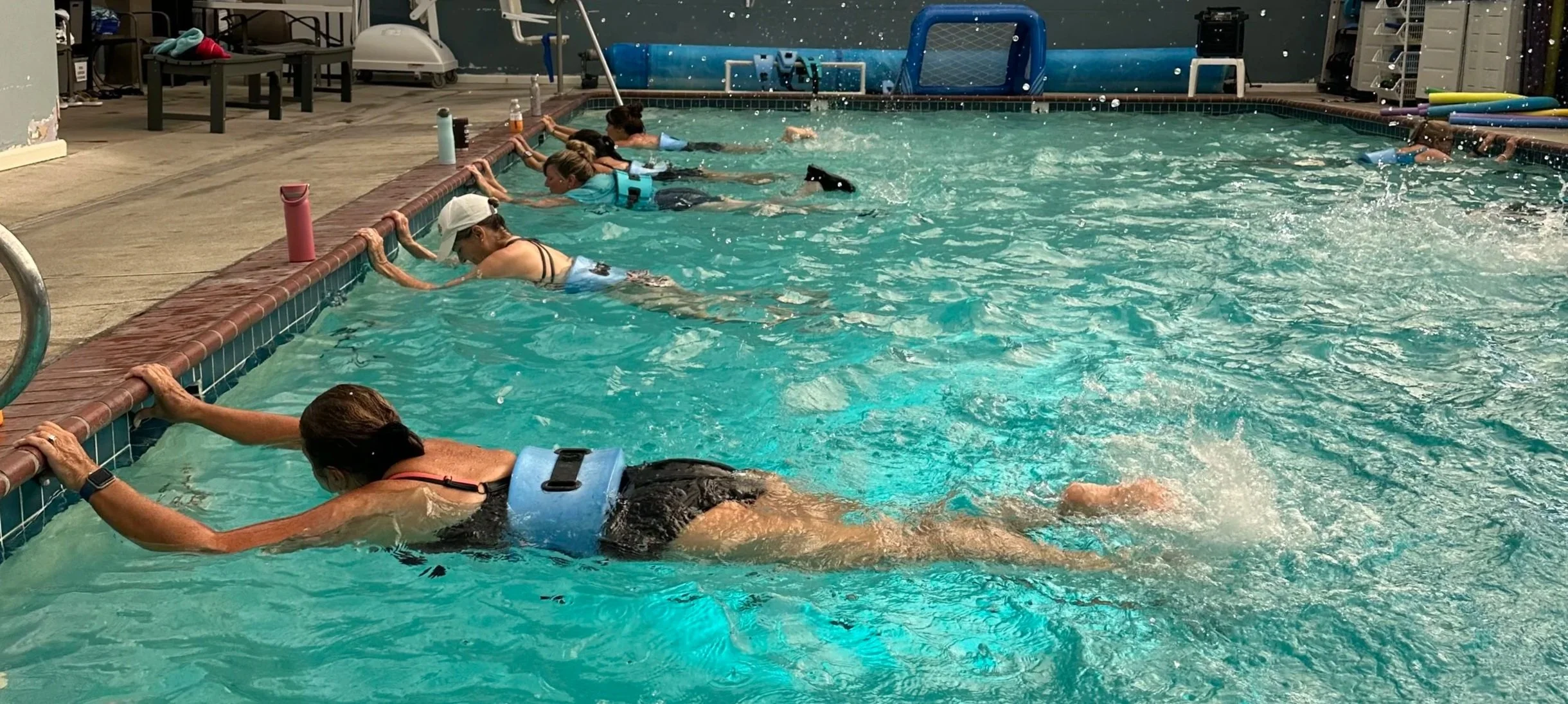
There shouldn’t be a one-size-fits-all approach when it comes to water fitness classes! In part 2 of our series, we share the ways classes differ from pool to pool, and we encourage you to find a pool that offers more than just “water aerobics”!
When I first started working at our pool (over 12 years ago!), there were two classes on the schedule: Water Aerobics and Arthritis/Fibromyalgia. The two classes were identical, with one exception: the clients in water aerobics used foam hand buoys for the entire class, and the clients in the arthritis class used resistance gloves. The exercises were listed on a small whiteboard (the routine rarely changed) and “Jock Jams” always played on Pandora. The fact that clients continued to attend those classes speaks volumes about the power of water.
Water fitness classes can vary dramatically from one pool to another: the size of the class, the pool depth utilized (i.e. shallow or deep), the class structure, the class’s intended difficulty level (i.e. beginner or advanced), and the expertise of the instructor can all play major roles. And yet, when chatting with potential clients on the phone, we often hear, “I’ve taken water aerobics before, so I’m sure I’ll be fine in your classes.” [Or even better, “No, I haven’t taken classes, but I’m a swimmer…” although that’s a conversation for another day!]. These same clients are then surprised to find themselves winded after warm-up and struggling to stay in place in our deep water workouts. They’ve never used the pool wall to exercise before or seen equipment beyond noodles or dumbbells, and they haven’t heard of a Tabata (“What did you call it? Ciabatta? Like the bread?”). It is then that they realize: all water fitness classes are not created equally.
Ideally, the classes offered at your own pool will also vary significantly in order to target different populations and/or fitness goals. However, it’s still quite common to find “Aqua Aerobics” as the only class on the schedule. In fact, a quick search of 8 local competitors here in Santa Barbara showed most athletic clubs offer 1 type of water fitness class with generic descriptions like this: “Aqua Aerobics: Tone and stretch all major muscle groups without stress to relaxing music.” (Sounds fun, sign me up!). If you’ve only taken “water aerobics,” you’re missing out!
A pool has the potential to be an aqua gym (or “liquid gym” as Aqua Pro Katy Coffey often calls it): your favorite land-based exercises and classes can be performed in the pool to reduce impact and take advantage of the properties of water. Rather than solely offering a traditional “water aerobics” class, you might find Aqua Boot Camp, Yoga, Spin, Zumba, Pilates, and HIIT on your weekly pool schedule (yes - POOL schedule!), offering you the opportunity to mix and match your water workouts, just as you would on land.
If you are lucky enough to have these options, it’s important that you attempt to take classes based on your fitness goals rather than solely looking at the time the classes are offered. We understand - if you’re working, have to pick up the kids from school, or have other workouts planned, you might not have much flexibility in your schedule. But all too often, we find clients don’t know what class they’ve signed up for. “Is today S’WET or Boot Camp?” “Will we be in the shallow end?” “Do I need a belt?”
Obviously, every facility is different, but here are a few differences among the classes we offer at Anderson Aquatics:
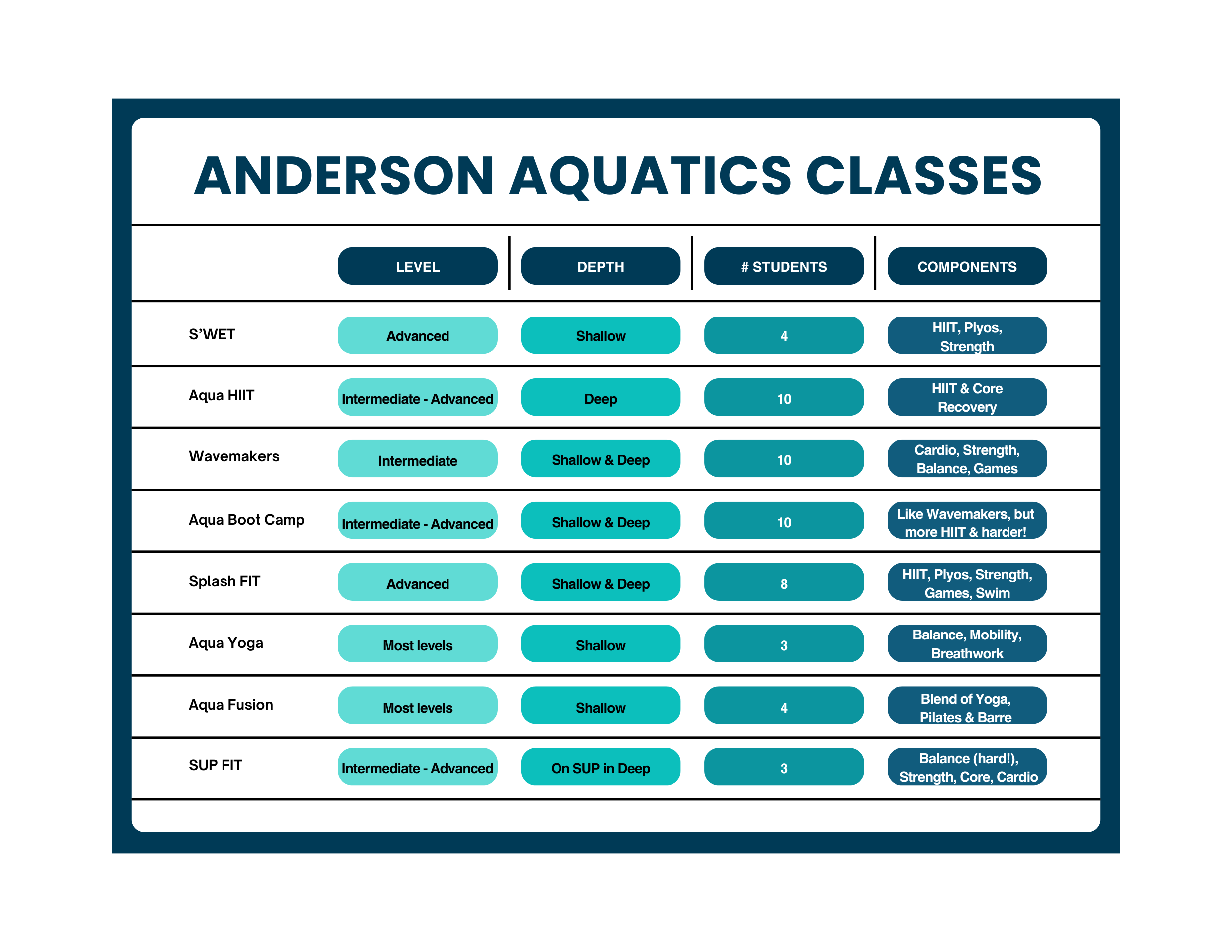
We create our class schedule with purpose, and these are some factors to consider when selecting your workout schedule at any pool, not just ours:
Difficulty Level — If you’re new to water workouts, you shouldn’t jump right into an “advanced” level class. An advanced level class assumes you have a good understanding of proper form with most shallow and deep water exercises, you have no limiting injuries, and you’re ready & willing to push yourself outside your comfort zone.
Depth - Traditionally, water fitness classes tend to be offered in shallow water. However, most of our classes have a strong deep water emphasis since the shallow end of our pool is so small (it was built as a scuba diving pool in the 60s or 70s). Aqua HIIT is a deep water only class at our pool, which is perfect if you have weightbearing precautions or need to limit your joint loading during cardiovascular exercise. However, there are benefits to shallow AND deep water exercise, and we encourage our clients to participate in both.
DEEP WATER (suspended; feet off the floor): Even our most “entry level” class (Wavemakers) is considered an “intermediate” class because it’s mostly in deep water, and new clients rarely have much experience exercising in deep water. Working out while suspended requires more coordination and core stability to stay in place, especially as one gets used to wearing a buoyancy device, like a belt or water horse. We use a variety of movements (stationary, traveling), body positions (vertical, pike, sidelying, prone), equipment, and games to challenge our students, in addition to wall work (kicking, wall squats, and core exercises).
SHALLOW WATER (weightbearing; feet usually on the floor): It’s easier to stabilize with your feet on the floor, so shallow water classes are usually best for beginners, nonswimmers, or clients who have some water phobia. Increased stability also allows for more upper body strengthening: With your feet anchored, you can put more speed and power into your upper body movements, and you can even use your arms out of the water for overhead strengthening (i.e. lifting a medicine ball). Shallow water is great for choreography-based classes (like Zumba and Kickboxing), for balance classes (like Aqua Yoga), and for advanced students who are ready for explosive, plyometric exercises.
Class Size - Our shallow water classes are always limited to 3-4 clients due to space. Splash FIT is limited to 8 to allow for more time in shallow water. Obviously, our pool is small, so even our largest classes have just 10 students — compared to larger pools, which can have upwards of 30-50 (!) students in a class. If socialization is your goal, the larger classes might be perfect for you. If you prefer a more intimate experience, where your instructor can give you more personalized instruction, you might look for classes at smaller pools like ours.
Class Components - A well-rounded exercise program consists of aerobic exercise, full-body strengthening, stretching, and some balance training. Consider your fitness goals and your other land-based activities (Are you working out with a trainer in the gym? Do you play pickleball or hike with friends? Do you take your dog on daily long walks?), then, when possible, select water fitness classes that fill in the gaps. Realize that your body does need "recovery” days, too; a HIIT workout may burn a lot of calories, but your body needs aerobic conditioning and strengthening (and rest!), too.
A pool has the potential to be so much more than a place for lap swimming and generic water aerobics classes. If you’ve only taken a traditional water fitness class, we hope you have the opportunity to try other formats in the pool… you have no idea what you’re missing! If you’re in the Santa Barbara area, we invite you to join us for a class or two so we can show you the power of the pool. New to water fitness? Sign up for a private class orientation, and we’ll teach you the basics & help you figure out the best class for you.
Content provided on this website is for informational and educational purposes only; it does not constitute providing medical advice or professional services. Always seek the advice of your physician regarding your health conditions and prior to initiating an exercise program.