All Pool Equipment Isn’t Created Equally: The Science Behind Your Favorite Pool “Toys” (Part 4 of 4)
Using pool equipment for your water workouts can be incredibly beneficial but only if you understand why and how to use it. The type of pool “toy” you’re using can significantly change muscle activation patterns, even when you’re performing the exact same exercise.
Let’s face it - the best piece of pool equipment is something you always have available: your body! The easiest and most cost-effective way to increase resistance and challenge your strength and cardiovascular system in the water is simply by using your body in different ways… no fancy equipment needed.
Need to make it harder? Move faster. Speed increases resistance exponentially.
Want more of a “core” challenge? Change your body position.
Working on power? Add plyometrics and move shallower.
Other standard pool features, like the stairs and the pool wall itself, can also be used to simulate functional tasks, increase weightbearing load, and add a fun new element to your water exercises.
Pool equipment is just icing on the cake.
Admittedly, we do like our pool toys, and new clients are often surprised by the variety of equipment that we have available at our aquatic center. We work with an incredibly diverse range of clients, from children to centenarians, and competitive athletes to individuals with post-operative conditions. Pool equipment allows us to customize our sessions, ensuring everyone is adequately challenged and able to progress their workouts safely and appropriately.
All pool equipment is definitely “not created equally” and varies quite significantly in cost and quality. At a very large aquatic facility, clients are often limited to the basics (noodles, kickboards, and hand buoys) since these items are less expensive and often used by swimmers, too. Specialized pool equipment may be more readily available at a small aquatic center that focuses mainly on physical therapy or water fitness (like ours!).
There are four primary types of equipment that we use when addressing strength, balance, and mobility in the pool:
Buoyant — dumbbells, kickboards, noodles, beach balls, enki boards
Drag — plastic bells, paddles, ankle/wrist fins, tennis rackets
Rubberized — cords, bands, resistance loops
Weighted — ankle weights, medicine balls, tidal tank
So what’s the difference? Unlike on land, where a 10-pound kettlebell, dumbbell, and barbell will all load your muscles the same amount and in the same way (when performing the same exercise), the type of pool equipment utilized will work your muscles in different ways.
Let’s consider a basic standing forward leg lift with a relatively straight knee.
Here’s how your equipment will affect the type of muscle contraction AND the muscles used when performing this exercise -
BUOYANT: With a buoyancy cuff strapped around the ankle, the hamstrings & gluts will work eccentrically as the leg lifts up and the hamstrings & gluts work concentrically as the leg moves down.
DRAG: With a resistance fin strapped around the ankle, the quads & hip flexors will work concentrically as the leg lifts up, and the hamstrings & gluts will work concentrically as the leg moves down.
RUBBERIZED: If a resistance band is anchored from behind and secured to the ankle, the quads & hip flexors will work concentrically on the way up and eccentrically on the way down (just like when using rubberized equipment on land).
WEIGHTED: When an ankle weight is strapped to the ankle, the quads & hip flexors will work concentrically on the way up and eccentrically on the way down (just like on land with or without equipment).
NO EQUIPMENT: Without any equipment, the buoyancy of water will assist the leg when moving up, and the hamstrings/gluts will work concentrically to pull the leg back down against buoyancy.
In a very deconditioned person with a very large and/or buoyant leg, the hamstrings usually work eccentrically on the way up to “control” the amount of lift.
However, as the speed of the leg lift increases, the hip flexors/quads will engage more (concentrically) on the way up as the leg pushes against the resistance created by the water.
If you’re an aquatic physical therapist, personal trainer, or water fitness instructor, you’re already familiar with these concepts. However, if you’re a client in one of our classes or training programs, these terms may sound a bit foreign. The important take-home messages:
Performing the same exercise on land and in the pool (without equipment) will often result in different muscle activation due to buoyancy. You can’t simply take your land-based exercise program to the pool and expect the same outcome.
Performing the same exact pool exercise with a different type of pool equipment can work totally different muscles. There’s a reason we have so many pool toys!
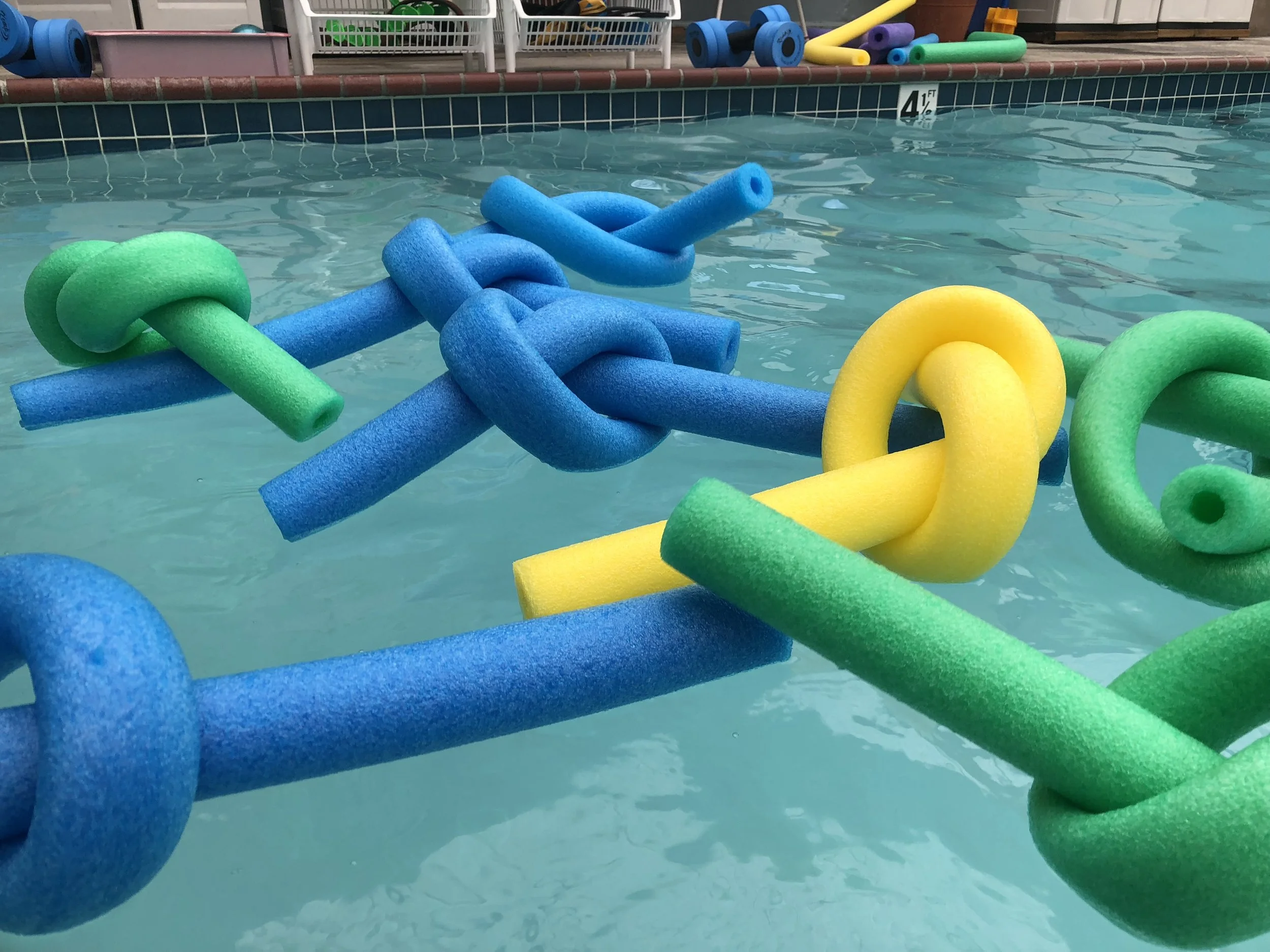
Ready for another example? A client recently asked us, “Some days you make me do swings with a noodle knot, and other days we use the ‘stick’ (aka Hydrorevolution Racket Trainer or Swing Trainer). What’s the difference? They seem similar.”
He’s right - they are quite similar. But here’s what we’re thinking about when selecting your equipment for this exercise:
Functional Grip Strength. The diameter of the noodle and the racket/swing trainer are different, requiring a slightly different grip. Think about how it feels to grip a golf club or broom stick vs. a water bottle or wine bottle and then consider whether you’re holding it with one hand or two. Our cross-body swings may be (primarily) a “core” exercise, but we’re thinking about these secondary muscle groups, too.
Buoyancy vs. Drag → Different Muscles. The noodle knot is a buoyant piece of equipment; the stick is a type of drag equipment. The noodle knot will float, requiring different muscles to submerge the noodle while swinging across the body. The stick feels heavier and is a bit more versatile: it will achieve resistance in all directions, including PNF diagonal patterns (like a tennis forehand or backhand)... the noodle knot will not.
Lever/Size. The length of the racket trainer, swing trainer, and noodle knot are all different. Quite simply, a longer lever will increase resistance.
Surface Area/Size. The amount of resistance can change because of surface area, too – pick a small, medium, or large diameter noodle, or select a small, medium, or large “fin” on the swing trainer. More surface area (larger equipment) = more resistance if you’re moving at the same speed.
While a creative instructor should be able to guide you through an effective water workout without any pool toys, she will have far more options to address your specific needs if she has access to specialized equipment. Of course, your aquatic center could also have a huge selection of expensive pool toys, and without an understanding of kinesiology and the properties of water, their potential will go unrecognized.
If you usually work out on your own and you’re still curious about how to use equipment for optimal results, you might take a look at one of our previous posts:
At Anderson Aquatics, you can be confident that your coaches create class plans and individualized exercise programs geared toward your specific needs. Pool toys may look fun (they are!), but they also have a purpose. We’re committed to instilling excellence, getting results, and teaching you how to harness the power of the pool, so reach out if you need more help or have questions!
Did you miss last week’s blog? Your coach can make or break your water fitness experience… Read more about the attributes of a high caliber water fitness instructor HERE.
Content provided on this website is for informational and educational purposes only; it does not constitute providing medical advice or professional services. Always seek the advice of your physician regarding your health conditions and prior to initiating an exercise program.